
The Myth of Self-Service Analytics, and How Agentic AI Changes That
Self-service analytics was a myth. Until now. Discover how Agentic AI replaces complex BI tools with autonomous, instant dashboard creation.
Marco Ciavarella
Co-Founder & CEO
For the last 15 years, the data industry has been selling a utopia: Democratize data. Give everyone a license. No more waiting on the data team to build your reports. It was the promise of "self-service analytics." And for the vast majority of organizations, it was a complete myth.
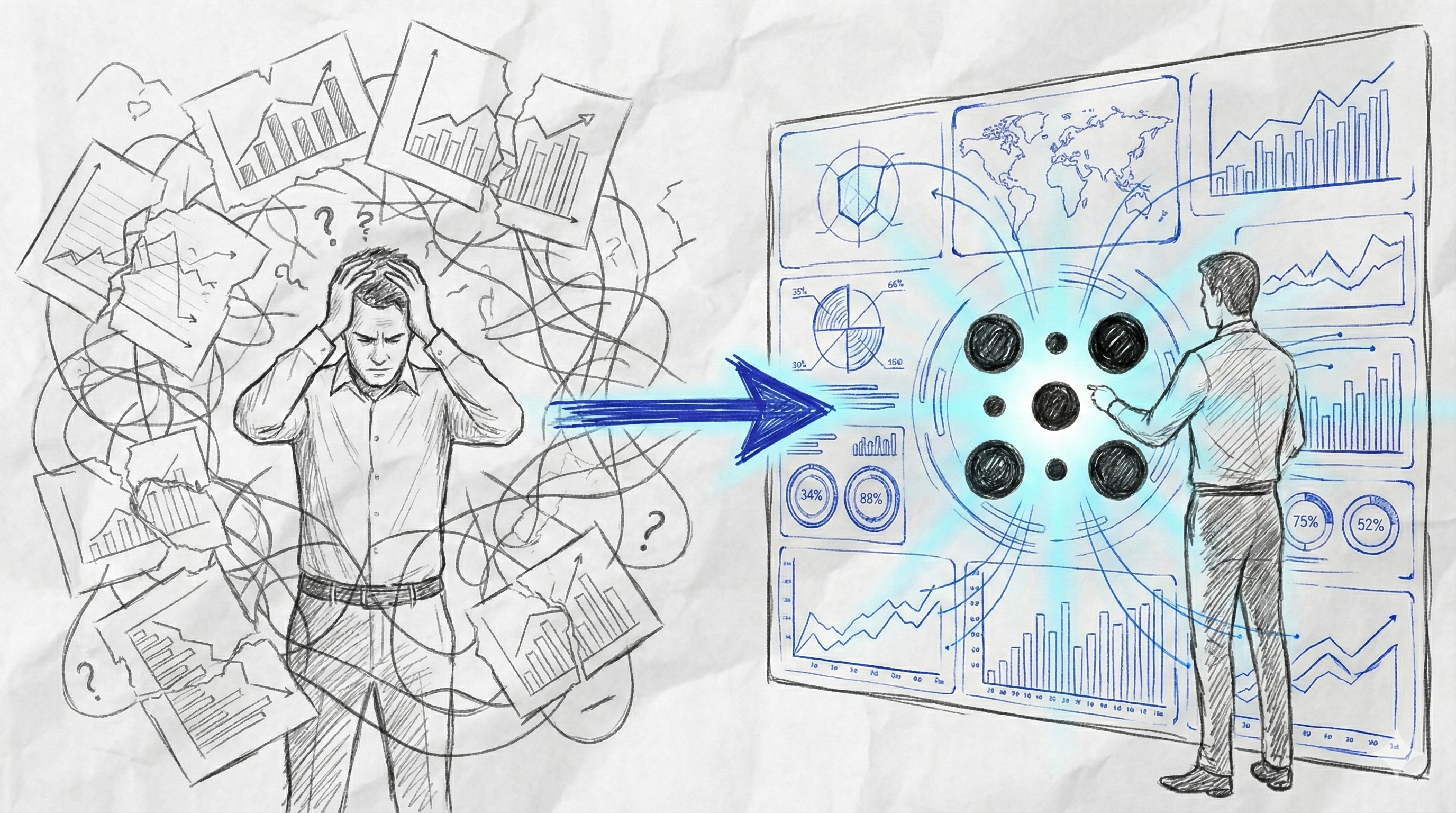
Instead of an empowered, data-driven workforce, the reality looks vastly different. We got dashboard sprawl—hundreds of abandoned, slightly-different charts cluttering our workspaces. We got confusing user interfaces that require weeks of training. And most tellingly, business users still end up Slacking the data team every time they need to change a single filter or add a new dimension.
True self-service analytics failed because legacy Business Intelligence (BI) tools required business users to think like data analysts. But the paradigm is finally shifting. We are moving from giving people complex tools to build their own charts, to giving them an AI agent that does the building for them.
Here is why self-service BI fell short, and how Agentic AI is finally making it a reality.
Why "Self-Service" Failed
The failure of traditional self-service BI usually boils down to three distinct bottlenecks:
- The Steep Learning Curve: Legacy tools are incredibly powerful, but expecting a VP of Marketing or a Sales Director to master data modeling, complex join logic, and proprietary formula languages between meetings was always unrealistic.
- The Data Prep Bottleneck: Business users still needed data engineers to clean, prep, and model the data before it could even be plugged into the BI tool. If the data wasn't perfectly modeled for a specific question, the user hit a wall.
- The "So What?" Problem: Even if a business user managed to successfully drag and drop their way to a bar chart, traditional tools stop there. They don't tell you what the chart means, why a metric dropped, or what action to take next.
Why Standard GenAI is Only a Stepping Stone
When ChatGPT arrived, many thought standard Generative AI would fix this. We saw a flood of text-to-SQL chatbots layered over databases.
Asking a chatbot, "What was our revenue last quarter?" is undoubtedly helpful, but it's a band-aid, not a cure. Standard GenAI simply translates text into code. It lacks deep contextual understanding of your business, it frequently hallucinates when database schemas get complex, and it struggles to proactively design the optimal visual representation of the data it retrieves.
Standard GenAI acts like a translator. What business users actually need is a teammate.
The Shift to Agentic AI
This is where Agentic AI changes the game. While standard AI models respond to single prompts with single answers, an Agentic AI possesses autonomy and reasoning capabilities.
An AI Agent doesn't just execute a command; it pursues a goal. When given a complex data request, an Agentic AI can:
- Plan: Break the user's overarching question down into a logical sequence of analytical steps.
- Execute: Write the queries, navigate across multiple data sources, and join the necessary tables.
- Evaluate: Check its own work, identify anomalies, and self-correct if a query returns an illogical result.
- Design: Autonomously decide the absolute best way to visualize the answer—knowing when a scatter plot is better than a line chart—and generate it instantly.
Agentic AI understands business context, remembers past interactions, and navigates data without requiring the user to hold its hand.
How Agentic AI Makes Self-Service a Reality
Let's look at what this means in practice. Imagine a Sales Director wants to know why Q3 enterprise deals dropped in Europe.
The Old Way: The Director submits a Jira ticket to the data team. Three days later, they get a link to a dashboard. They realize the dashboard doesn't segment by specific product lines in Germany, so they request a change. They wait another day. The moment has passed.
The Agentic Way: The Director asks their AI agent, "Why did our Q3 enterprise revenue dip in Europe?" The agent autonomously investigates the CRM data. It identifies that while overall European pipeline was healthy, there was a specific drop in enterprise deal sizes in the DACH region due to elongated sales cycles. The agent recognizes that a waterfall chart is the best way to show this variance, generates the visualization, and adds a natural language summary explaining the root cause.
Total time? Seconds. Zero Jira tickets required.
Enter Viz: The Frontier Dashboard-Building AI Agent
This is why we built Viz.
At Exmergo, we recognized that the world doesn't need another drag-and-drop dashboard builder. It needs an intelligent partner that does the heavy lifting for you. We built Viz as a native Agentic AI Platform specifically designed for data visualization.
Viz delivers on the broken promise of self-service by acting as an always-on data analyst for every member of your team:
- Autonomous Data Wrangling: Viz navigates your messy, real-world schemas so your users don't have to.
- Intelligent Chart Selection: It doesn't just fetch numbers; it proactively designs the perfect, presentation-ready visualizations based on cognitive best practices.
- Proactive Insights: Viz doesn't just show you the data; it tells you the story behind it, highlighting the "why" so your team can focus on the "what next."
But the true power of Viz lies in how it bridges the gap between autonomous AI and human intuition. Viz builds the initial dashboard for you in seconds. You can then have Viz edit the generated charts, metrics and queries for you. That way you remain in full control of the output, while Viz does the number-crunching and styling adjustments.
Once your dashboard is perfected, you can instantly share it with your team in a secure "read-only mode." This ensures everyone is aligned on a single source of truth, without the risk of accidental edits or broken formulas.
The future of analytics isn't teaching business users how to build charts from scratch. It's giving them the power to ask the right questions, an Agentic platform capable of answering them, and the flexibility to polish the final result.
Stop building dashboards from scratch. See how Exmergo Viz represents the dashboard's frontier AI Agent.